English
  中文简体
中文简体 Run your hand across a well-made jacquard and you can feel the pattern before you see it. The raised floral on an armchair, the diamond texture on a dress, the crest on a school uniform: all of it is knitted or woven into the structure of the cloth itself, not printed on the surface. Customers ask us how jacquard fabric is made almost every week, and because we produce it on our own circular knitting machines every day, we would like to walk you through the entire process, from design file to finished roll.
What Makes Jacquard Different From Printed Fabric
On a printed fabric, color sits on top of a cloth that has already been made. On jacquard, the pattern is the cloth. Individual yarns are lifted, tucked, or hidden at precise points, so the motif and the fabric structure are created in the same motion.
The principle is older than you might expect. Joseph Marie Jacquard's loom of 1804 used holes punched into stiff cards to control which threads rose on each pass, an idea that later helped inspire modern computing. Today's machines keep the same logic but swap the cards for electronic selectors, so a digital design file tells every needle exactly what to do. Because the pattern is structural rather than surface level, jacquard resists fading and abrasion far better than print, often looks good from both faces, and carries a dimensional texture that flat printing simply cannot imitate.
How Jacquard Fabric Is Made, Step by Step
The details vary between woven and knitted jacquard, but the journey is broadly the same. Here is how we produce knitted jacquard on our circular machines, one stage at a time.
Step 1: Create and Digitize the Design
Every jacquard begins as artwork. We convert a customer's sketch, physical sample, or drawing into a clean repeat, the tile of pattern that must flow seamlessly across the full width of the fabric. The design is then mapped onto a grid in which each point corresponds to one needle and one course of stitches. Color is limited by the number of yarn feeders a machine can carry, so we plan color placement carefully at this stage instead of discovering problems halfway through production.
Step 2: Select and Prepare the Yarn
Yarn choice defines the hand feel, stretch, and cost of the finished cloth. Polyester is our workhorse thanks to its strength and colorfastness; we blend in spandex where elasticity matters and pair in softer filaments when a smooth, silky surface is the goal. We knit across fine deniers such as 50D and 75D for light, drapey fabrics, and up to 100D or 150D when a heavier, more abrasion-resistant hand is needed. Yarn is wound onto cones, checked for even tension, and either dyed before knitting for multicolor patterns or reserved for piece dyeing later.
Step 3: Set Up the Jacquard Knitting Machine
Knitted jacquard is made on large circular machines fitted with electronic needle-selection systems. Our workshop runs more than 100 double-sided and 80 single-sided circular machines in 34-inch and 38-inch diameters, at gauges of 24, 28, and 32 needles per inch. Before production, technicians load the pattern file, thread each feeder, and run a short trial length. Each needle can be instructed to knit, tuck, or miss on any given course, and it is this three-way decision, repeated millions of times, that draws the pattern into the cloth.
Step 4: Knit the Pattern
Once the trial is approved, production runs continuously: the cylinder rotates, feeders lay down yarn, and the selector addresses needles course by course. Where a needle knits, the stitch shows on the face; where it tucks or misses, the yarn floats to build contrast, raised lines, or a hidden background. For double-faced jacquard, the dial needles knit a second layer at the same time, locking the whole structure together. Operators watch the roll throughout the run for needle lines, dropped stitches, and repeat alignment.
Step 5: Dye, Finish, and Inspect
Yarn-dyed jacquard leaves the machine already patterned in color and needs mainly washing, softening, and heat setting to stabilize the width. Piece-dyed jacquard is scoured and dyed first, then finished so the texture really pops. Every lot then passes inspection under strong light, where we confirm weight, hand feel, dimensional stability, and color fastness before the fabric is rolled, packed, and shipped.
| Stage | What Happens | Why It Matters |
|---|---|---|
| Design and digitizing | Artwork is converted into a needle-by-needle repeat file | Locks in pattern accuracy and color count |
| Yarn preparation | Fibers and deniers are chosen, wound, and tension-checked | Controls hand feel, stretch, and durability |
| Machine setup | Pattern file loaded, feeders threaded, gauge and diameter set | Ensures the motif lands exactly on target |
| Knitting | Needles are selected to knit, tuck, or miss, course by course | Builds the pattern into the structure itself |
| Dyeing and finishing | Washing, dyeing, heat setting, and softening | Stabilizes width and enhances texture |
Single, Double, and Transfer Jacquard: Three Ways to Build the Pattern
Ask three mills about jacquard and you may hear three different descriptions, because the name covers several distinct constructions. These are the three we produce most often.
Single Jacquard: Pattern on One Side
Single jacquard forms the motif on the face of the fabric while the back carries floats or a simple ground stitch. It is lighter and more economical than double-faced cloth, which is why it turns up everywhere from dresses to sofa covers. For a deeper look at the construction, our single jacquard guide compares it directly with double jacquard and explains where each performs best.
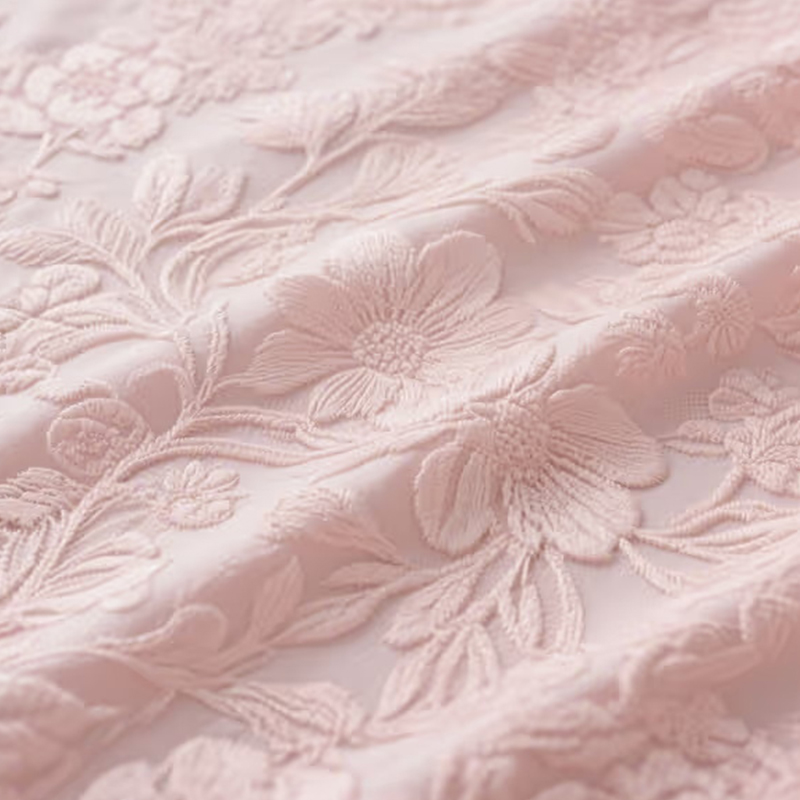 Upholstery Single-Sided Jacquard FabricFollowing the discussion of single jacquard's lighter, economical face-patterned construction, this fabric shows how the same knit delivers crisp three-dimensional motifs with a flat reverse for apparel and home uses.View Product →
Double Jacquard: Two Sides, One Stable Structure
Double jacquard is knitted on the cylinder and the dial at the same time, producing a patterned face, a tidy back, and a fuller, more stable body. That two-sided integrity makes it a favorite for heavy apparel, cushions, and throws that must hold their shape through years of use. Our thick double-faced jacquard shows how dense and substantial this construction can feel while keeping every line of the pattern crisp.
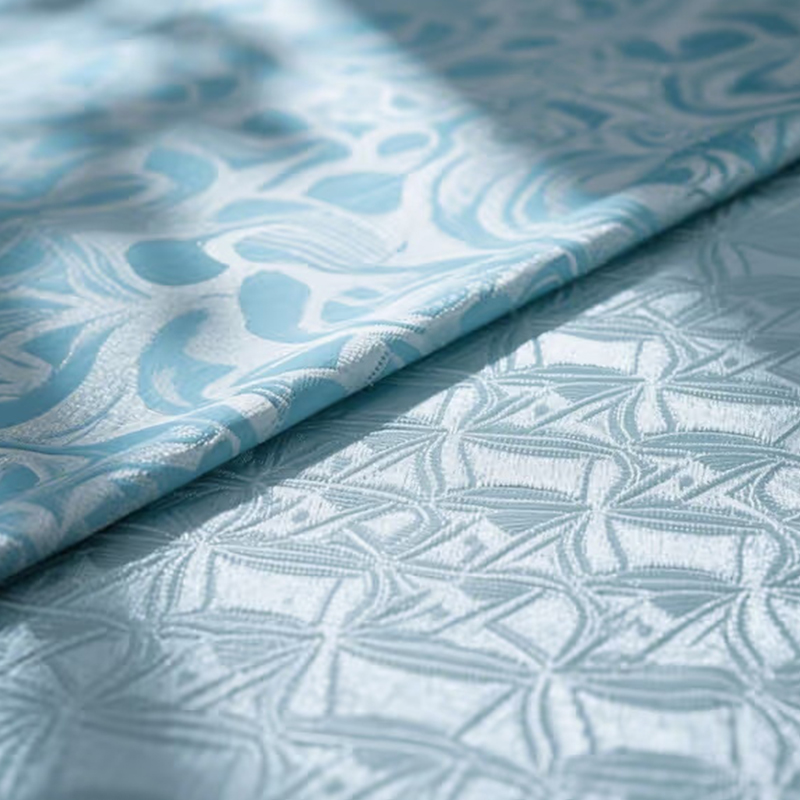 Thick Double-Faced Jacquard FabricAfter explaining double jacquard's patterned face, tidy back, and fuller stable body, this fabric demonstrates that density and substance, keeping patterns crisp for heavy apparel, cushions, and throws.View Product →
Transfer Jacquard: Depth, Relief, and Openwork
Transfer jacquard moves stitches between needle beds during knitting, unlocking effects the other two constructions cannot reach: hollow reliefs, sculpted raised surfaces, and lace-like openings. It is what we reach for when a customer wants a pattern that casts an actual shadow rather than simply showing color, and it turns a flat motif into something you can genuinely feel.
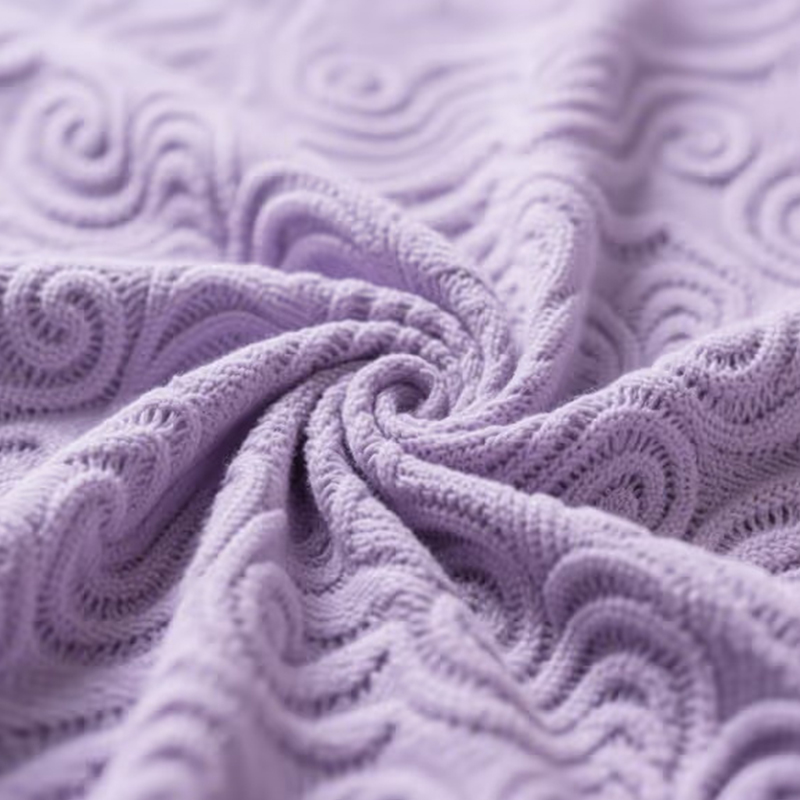 Hollow Convex Transfer Jacquard FabricFollowing the description of transfer jacquard's sculpted reliefs and lace-like openings, this fabric shows those hollow, raised effects in a breathable knit suited to summer clothing and home decor.View Product →
What Buyers Should Check Before Ordering Jacquard Fabric
Jacquard earns its place in apparel, activewear, school uniforms, upholstery, and home textiles because the pattern never washes off. Before you commit to a supplier, we recommend checking a few practical points:
- Pattern repeat: measure across the full width to confirm the motif lines up from edge to edge.
- Weight and hand feel: grams per square meter tells you one story, but touching the cloth tells you the rest.
- Color fastness: ask for test results on washing, rubbing, and light exposure, not just a promise.
- Dimensional stability: a good jacquard should hold its shape after repeated laundering.
In our own factory, all of these checks are built into the production line, with professional inspectors stationed at every step, a habit we have kept since opening our doors in 2016. With more than 100 ready-made samples in stock and a development team that works from your artwork or physical sample, we can put something close to your target in your hands quickly, then scale it for volume orders. Our plant sits near the port, so finished rolls reach domestic and overseas customers without delay.
At Shaoxing Yihan Textile, we like to say jacquard is where engineering meets decoration, and now that you know how it is made, you can judge both. If you have a pattern in mind, send it over and we will tell you honestly which construction suits it best.