English
  中文简体
中文简体 Open the wardrobe of any well-dressed person, and you will likely spot a jacquard fabric—its pattern does not fade or peel because it is not printed on the surface. Jacquard fabric is woven with the design built directly into the structure, making it exceptionally durable and texturally rich. The key question for buyers, designers, and fabric engineers is: how is jacquard fabric made? The answer involves precise control of individual warp yarns, a process that has evolved from punched-card looms to modern computer-controlled machinery. In this article, we walk through the entire manufacturing sequence, from raw fiber to finished cloth, and highlight the commercial options available for your next project.
What Defines a Jacquard Fabric?
Before examining the steps, it is important to understand that jacquard is primarily a weaving or knitting technique, not a specific fiber or weight. In a conventional loom, heddles lift groups of warp threads to create simple weaves. A jacquard mechanism, however, controls each individual warp end independently, allowing infinite variations of pattern and texture. This is why a jacquard fabric can simultaneously have a satin background, a ribbed border, and a floral motif—all in the same weave. The same principle applies in modern jacquard knitting machines, where individual needles are selected to form loops that create the pattern. The result is a cloth whose design is structurally integrated, meaning it will not wash out, rub off, or lose clarity over time.
The Step-by-Step Process of Making Jacquard Fabric
The production of jacquard fabric involves six core stages, each requiring careful material selection and machine preparation. Below we break down each stage.
1. Yarn Selection and Preparation
Everything starts with the fiber. Cotton, silk, polyester, nylon, and blends are all common choices, depending on the intended end use—apparel, upholstery, or sportswear. The yarn’s count (denier or Ne), twist level, and evenness directly affect how clearly the jacquard pattern appears. For example, a 75D polyester yarn with medium twist produces a clean, sharp pattern, while a coarser 150D yarn gives a more pronounced texture. At this stage, the yarn is also wound onto cones for the warping process.
2. Warping the Yarn
Warp yarns run lengthwise in the fabric and must be arranged in a precise parallel sheet. A warping machine winds hundreds or thousands of ends from individual cones onto a single warp beam, maintaining uniform tension. For jacquard weaving, the number of ends can range from a few hundred to several thousand, each corresponding to a potential lifting point on the jacquard machine. If tension is uneven, the pattern will shift or appear distorted after weaving.
3. Pattern Design and Machine Programming
The design is first created as a digital image or a grid of colors, each color representing a different weave structure. This image is then converted into a “lift plan” using specialized CAD software. In computerized jacquard looms, the lift plan is loaded directly into the loom’s controller, which sends signals to the jacquard head. Each warp end is assigned a set of instructions: up for one pick, down for the next. Modern machines can handle patterns with thousands of picks, and the design can be modified instantly without changing mechanical parts. This is a massive improvement over the original punched-card system, where each card pattern was fixed.
4. Weaving or Knitting
The actual interlacing happens on the loom or knitting machine. In a weaving jacquard, the warp sheet passes through the jacquard head, and each end is lifted or left down according to the pattern. A weft insertion device (shuttle, rapier, or air-jet) then places the weft yarn across the open shed. The cycle repeats at speeds of several hundred picks per minute for modern looms. In a jacquard knitting machine—common for apparel and sportswear—the needles are selected individually to form knit loops; the pattern appears as a combination of knit, tuck, and miss stitches. For instance, many polyester double jacquard fabrics produced today are made on large circular knitting machines with electronic needle selection, achieving speeds up to 30 rpm while maintaining pattern precision.
5. Finishing Treatments
After the fabric comes off the machine, it undergoes finishing to stabilize dimensions, enhance hand feel, and add performance properties. Typical steps include scouring (removing spinning oils), heat setting (for synthetic fibers), bleaching or dyeing if the yarn was raw, and mechanical finishing like calendering or brushing. Some jacquard fabrics are piece-dyed after weaving, which can highlight the pattern through differential dye uptake: different yarn types or weaves absorb color differently, creating a tone-in-tone effect. For functional applications, water-repellent, anti-pilling, or flame-retardant finishes can be applied. Quality control checks during finishing ensure that the pattern repeats are aligned and that no skipped threads exist.
Common Types of Jacquard Fabric and Their Uses
Understanding the different constructions helps buyers select the right fabric for their specific application. Below we outline three major types produced in modern textile mills.
Single-Side Jacquard
In single-side jacquard, the pattern is visible on only one face of the fabric; the reverse side shows a simpler or even plain structure. This is commonly used for upholstery, lined garments, and decorative trims because the pattern stands out sharply on the right side while the back side is clean for laminating or lining. Our 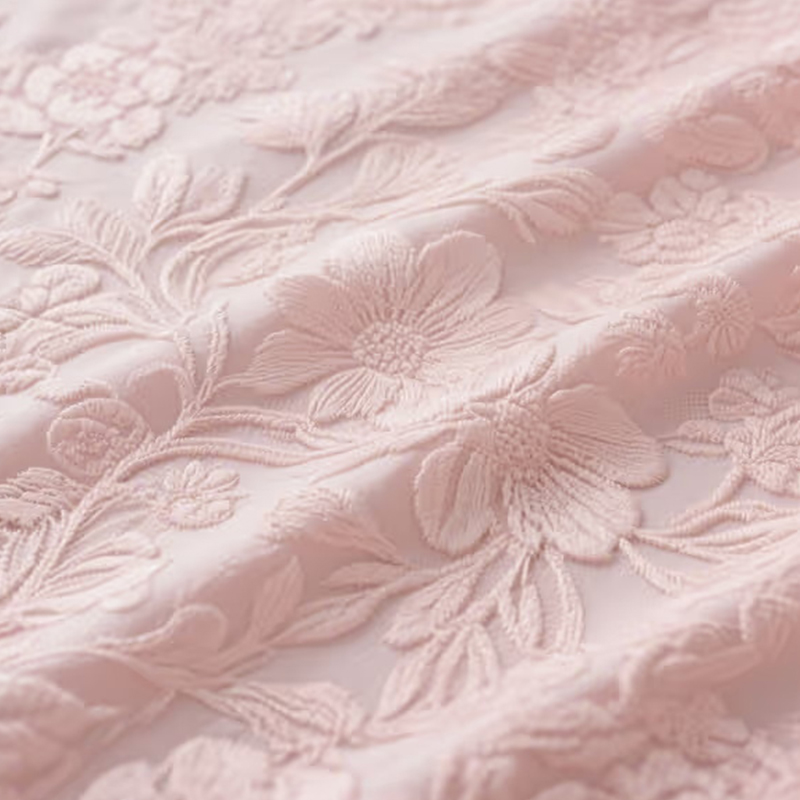 Upholstery Single-Sided Jacquard Fabric with Fade ResistanceThis single-sided jacquard fabric displays intricate patterns on the right side with a flat reverse, ideal for sofas and headboards. It provides dimensional stability and fade resistance for long-lasting upholstery use.View Product → is designed for sofas and headboards, offering dimensional stability and fade resistance.
Double-Side Jacquard
As the name suggests, double-side jacquard features intricate patterns on both sides of the fabric, often in contrasting colors or textures. This is achieved by weaving two layers simultaneously and interlocking them at certain points. Double jacquard is thicker, more substantial, and reversible—ideal for scarves, blankets, and high-end fashion where both sides may be visible. A typical example is the 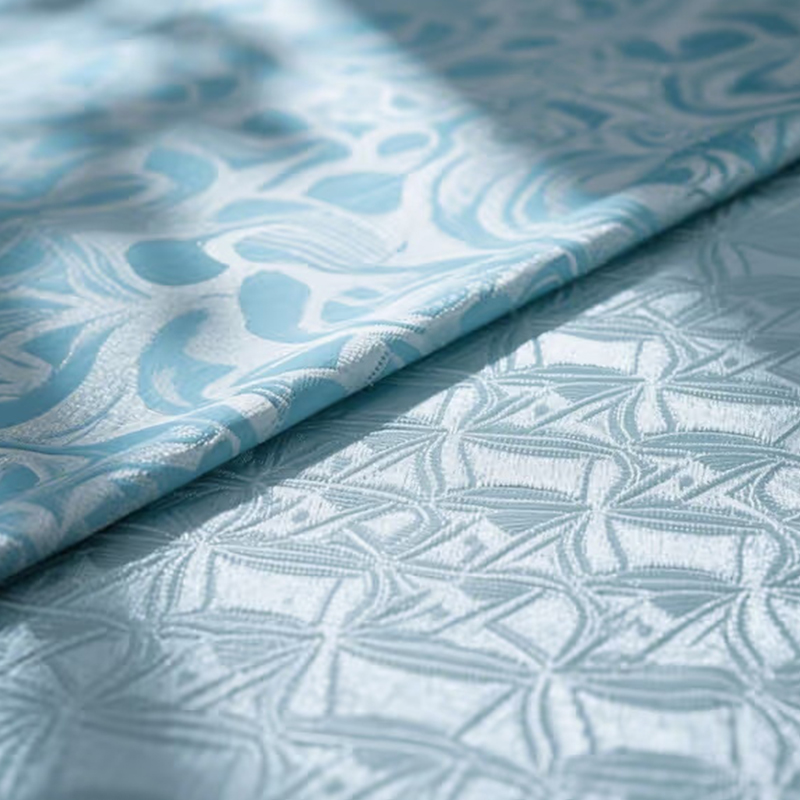 Thick Double-Faced Jacquard Fabric for Warmth and VersatilityThis reversible jacquard fabric features intricate patterns on both sides, offering a thick, durable texture. It is well-suited for scarves, blankets, and winter outerwear where both sides are visible.View Product → used for winter outerwear and premium home textiles.
Transfer Jacquard
Transfer jacquard is a variation used primarily in warp knitting. The pattern is created by transferring loops from one needle to another, producing openwork, blister, or raised effects. This technique yields lightweight, breathable fabrics with a three-dimensional texture, popular for activewear and luxury lingerie. Our 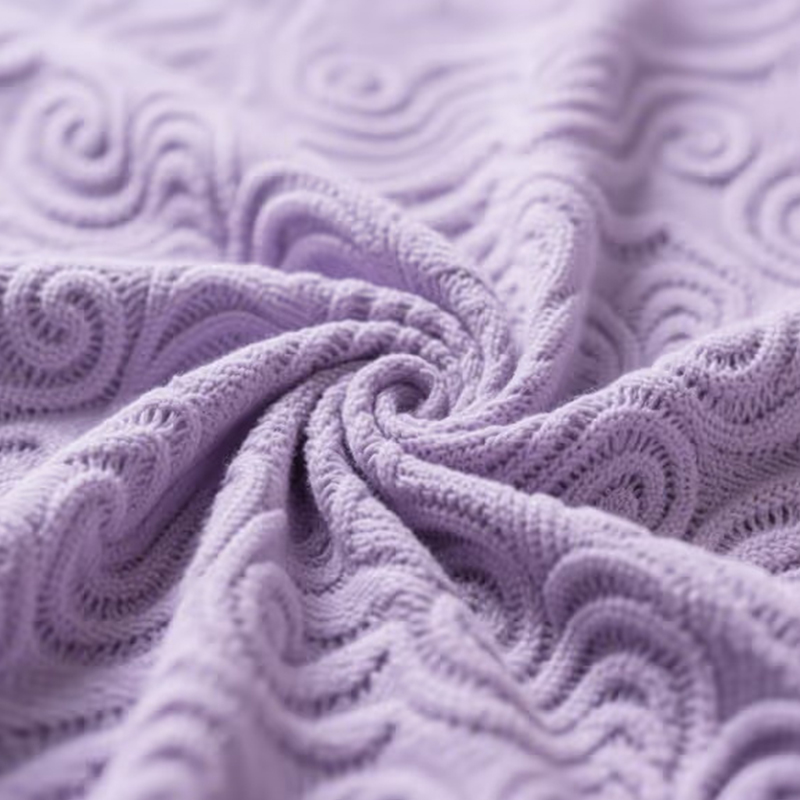 Hollow Convex Transfer Jacquard Fabric with Breathable TextureUsing innovative transfer technology, this fabric creates three-dimensional hollow patterns with excellent breathability and soft touch. It is ideal for summer apparel like sweaters and home decor items.View Product → exemplifies the unique tactile and visual depth achievable with this method.
Why the Manufacturing Process Matters for Quality
Every stage in the jacquard production chain influences the final product’s performance. Choosing the wrong yarn count can make a fine pattern appear blurry. Inconsistent tension during warping leads to bowed or skewed patterns. Improper heat setting may cause shrinkage after washing. For buyers, the takeaway is clear: a reliable jacquard fabric comes from a mill that controls all these variables. Our factory, with over 180 knitting machines and strict in-line inspection, ensures that each lot meets the required pattern accuracy, colorfastness, and dimensional stability. If you are evaluating jacquard fabric for your next collection, you can read more about the key quality indicators of jacquard fabric to make an informed decision.
From yarn to patterned cloth, jacquard fabric remains one of the most sophisticated textile technologies available. Its ability to incorporate complex, permanent designs without printing makes it a staple in fashion, home decor, and technical textiles. By understanding the complete how-it’s-made journey, you can better assess suppliers, anticipate costs, and specify the exact construction your product requires.